
"FOMO FlockTrading" Bids Equities!
No Recession on the Way!

KR Opinion
As I reflect on my years on Wall Street as an analyst, trader, and software developer, I'm struck by how market sentiment has become bolder and more volatile. This is partly due to our modern communication channels like YouTube and Twitter, which amplify and accelerate market reactions.
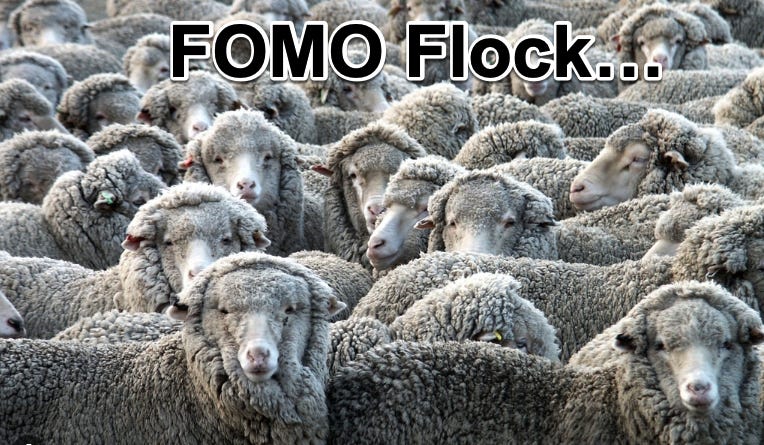
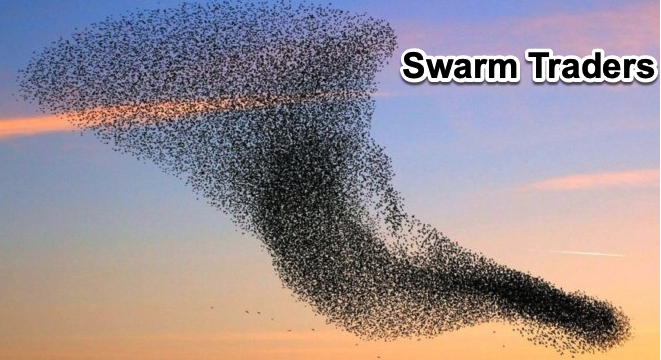
I've started using new terms to describe the phenomena I'm observing. "FOMO Flock Trading" (FFT) and "Swarm Trades" capture the stampede-like behavior we're seeing in the markets. Today was a prime example - waves of traders swarming right from the market open, creating a frenzy throughout the session.
While many view big rallies as purely positive, my experience on trading floors tells a different story. I remember standing at the bottom of the long escalator at the Chicago Board of Trade, watching traders' faces as they came down.
You could instantly tell how their day went - whether they were laughing, heading out for drinks, or hanging their heads in defeat. Days like today, with sharp reversals catching many on the wrong side, leave a lot of casualties in their wake.
Watching the level 2 trading data today, I saw liquidity completely dry as the market exploded at the open. The number of contracts on the bid-ask spread thinned dramatically, with the S&P running up 4, 5, and even ten handles (100-point increments) in vertical moves. Clearly, these were panic "Get Me Out" orders - traders buying at any price to exit their positions.
This frenzy didn't just last for the first couple of hours; it persisted throughout the session. The market would grind sideways, pull back slightly, then surge to new highs. By the close, we were near session highs, with buying continuing in overnight trading.
It's fascinating how quickly sentiment has shifted. On August 2nd, after the employment numbers were released, everyone talked about an impending recession. Now, just two weeks later, on August 16th, we're seeing a completely different narrative. I've maintained that I don't see a recession on the horizon, and now the data is backing that up with solid indicators and a significant market rotation.
The patterns we're seeing are pure volatility. I suspect we're close to completing the first cycle of this movement, and the next few days will be crucial in determining what the rest of August might look like.
In all my years in the markets, I've never seen sentiment be so consistently wrong. These cycles of extreme positioning create tremendous volatility, amplified by the constant communication on social media platforms. It leads to "FOMO flock Trading" - groups of traders piling into the same ideas based on their favorite commentators, creating massive swings as they fear missing out.
Charles Schwab's decision to offer fractional shares in 2019 was a significant factor contributing to this new market dynamic. While Robinhood had already introduced this feature, Schwab's move as a significant brokerage firm was a game-changer. This, combined with the elimination of transaction fees, opened the door for many new investors and dramatically increased market liquidity. However, it has also intensified the volatile events we're witnessing.
I expect we'll continue to see plenty of these extreme moves in the future. However, there's a risk that this could eventually burn through many traders' capital, as these events often result in significant losses, especially for short-term traders in options, futures, or day trading stocks.
The spikes we see now are much more exaggerated than anything I've witnessed. Prices can move incredibly hard when liquidity in the bid-ask spread starts to thin out. I plan to analyze price discovery and movement mechanics more in-depth in a future report or video.
As we wrap up this week, we will likely see this strong bid continue into Friday and Monday. The volatility remains enormous, and I'll closely monitor how these market dynamics evolve in the coming days and weeks.
Looking Back on Thursday Action!
In a dramatic turnaround, the stock market surged today, with all major indices posting significant gains. The Dow Jones Industrial Average rose 1.4%, while the S&P 500 climbed 1.6%. The tech-heavy Nasdaq Composite outperformed, jumping 2.3%, and the small-cap Russell 2000 led the pack with a 2.4% increase.
This rally is a welcome relief after a turbulent start to August, triggered by a July jobs report that raised concerns about a potential economic slowdown. Today's economic data, however, painted a much rosier picture, prompting investors to return to the market with renewed confidence.
The July Retail Sales Report exceeded expectations, suggesting robust consumer spending and positive implications for corporate earnings. The weekly jobless claims report also eased fears about a weakening labor market, further bolstering investor sentiment.
Corporate earnings also played a significant role in today's upswing. Walmart reported solid results and offered optimistic commentary on consumer behavior, while Cisco Systems impressed with its fiscal fourth-quarter performance. Both stocks saw substantial gains, with Walmart up 6.6% and Cisco climbing 6.8%.
The rally was broad-based, with nine out of eleven S&P 500 sectors closing higher. Consumer discretionary and information technology led the charge, posting gains of 3.4% and 2.5%, respectively. Ulta Beauty was a standout performer in the consumer discretionary sector, soaring 11.2% after Warren Buffett's Berkshire Hathaway disclosed a new position in the company.
Only two sectors bucked the trend: real estate and utilities. These rate-sensitive sectors faced headwinds as market interest rates climbed. The yield on the 10-year Treasury note jumped 11 basis points to 3.93%, while the 2-year note yield rose 15 basis points to 4.10%, reflecting growing optimism about the economic outlook.
Today's market action reminds us how quickly sentiment can shift on Wall Street. As we move forward, investors will be closely watching further economic data and corporate earnings reports to gauge the strength of the U.S. economy and the direction of future market moves.
· Nasdaq Composite:+17.2% YTD
· S&P 500: +16.2% YTD
· S&P Midcap 400: +8.2% YTD
· Dow Jones Industrial Average: +7.6% YTD
· Russell 2000: +5.4% YTD
Reviewing Thursday’s economic Releases:
The August Philadelphia Fed Index came in at -7.0, down from the previous 13.9.
July Retail Sales showed a surprising 1.0% increase, surpassing the KR Forecast consensus of 0.3%. The prior month's figure was revised down to -0.2% from 0.0%. Retail Sales, excluding auto, rose 0.4%, beating the KR Forecast consensus of 0.2%. The previous month's ex-auto figure was revised up to 0.5% from 0.4%.
Notably, the increase in retail sales outpaced inflation in July, suggesting that improved demand, not just price increases, drove the growth.
Weekly Initial Claims were 227,000, below the KR Forecast consensus of 232,000. The previous week's figure was revised up to 234,000. Continuing Claims fell to 1.854 million from a revised 1.871 million. These numbers remain well below levels typically associated with recessionary conditions.
July Import Prices rose 0.1%, unchanged from the previous month. Import Prices excluding oil also increased by 0.1%, down from 0.2% previously. Export Prices jumped 0.7%, a significant improvement from the revised -0.3% in June. Export Prices excluding agriculture surged 1.0%, rebounding from a revised -0.4%.
The August NY Fed Empire State Manufacturing index improved to -4.7 from -6.6.
July Capacity Utilization fell to 77.8%, below the KR Forecast consensus of 78.6%. The previous month's figure was revised down to 78.4%. Industrial Production decreased by 0.6%, contrary to the KR Forecast consensus expectation of a 0.1% increase. The prior month's figure was revised down to 0.3%.
It's worth noting that Hurricane Beryl significantly impacted these figures, reducing industrial production by an estimated 0.3 percentage points and manufacturing output by about 0.3%.
June Business Inventories rose 0.3%, slightly above the KR Forecast consensus of 0.2%.
The August NAHB Housing Market Index dropped to 39, below the KR Forecast consensus of 43. The previous month's figure was revised down to 41.
Looking ahead, Friday's economic calendar includes July Housing Starts and Building Permits at 8:30 ET, followed by the preliminary August University of Michigan Consumer Sentiment survey at 10:00 ET.
WaveTech Database
The massive rally we've experienced over the last several days has triggered a substantial influx of new entries in our short-term database. We've seen 3,981 new entries and 156 exits, pushing the bullish percentage to 54.02%.
