
Is The Fed on Pause Already?
Bitcoin Ready to move higher...

KR Opinion
As we close out the week, the market's remarkable resilience and persistent bullish sentiment continue to dominate the landscape. This unwavering optimism prompts a reevaluation of earlier predictions about the Federal Reserve's upcoming moves. Reflecting on my comments after the last Fed meeting, I'm convinced that a rate cut in November is unlikely. If the solid economic data trend persists, we might even see the December meeting pass without action.
The employment figures have remained impressively robust, and the recent significant drop in expected jobless claims only reinforces the rosy economic picture as we approach year-end. This strength in the labor market is a crucial factor driving optimism.
When considering what the market is pricing in, it's clear that a wave of optimism is flowing through. Interestingly, there is little reason to doubt this positive sentiment. The recession fears, and other pessimistic narratives that once dominated discussions have largely faded into the background. However, this widespread complacency could be more dangerous than when these concerns peaked.
The banking sector has seen substantial activity, and incoming earnings reports paint a picture of robust corporate health. Major indices remain in double-digit growth territory for the year, an impressive feat given that we're just two and a half months from year-end, facing a major general election and numerous other uncertainties. Yet, the market appears unshakeable in its confidence.
This aligns with my longstanding view that we're not headed for a recession. Looking ahead to 2025, I anticipate further adjustments on the front end of the yield curve. My projection places the federal funds rate and one-year maturities in the 3% to 3.5% range. Notably, the back end of the curve is also moving up, with the 10-year yield approaching 4.10%. I interpret this as a positive sign, confirming that the economy is stronger than many will acknowledge.
As this week wraps up, we've seen some earnings reports, but nothing dramatically shifted overall market sentiment. The high probability scenario continues this bull market push with relatively low downside risk.
It's crucial to remember that this optimism persists against a backdrop of potential uncertainties, including the approaching general election. The market's ability to brush off these concerns underscores the perceived strength of the current economic narrative.
However, vigilance remains key. A lack of concern about potential risks could become a risk factor. Markets that become too complacent can be more vulnerable to unexpected shocks. In the coming weeks, we'll need to closely monitor upcoming economic data releases, any shifts in Federal Reserve rhetoric, global economic landscape developments, and the progression of the election season.
While the current outlook leans positive, maintaining a balanced perspective and preparing for potential volatility is crucial. The market's resilience has been impressive, but prudent risk management remains as crucial as ever in this dynamic economic environment.
Looking Back on Thursday’s Action
As the closing bell rang today, the market presented a nuanced picture, with major indices charting different courses. The S&P 500 and Nasdaq Composite hovered near their previous closing levels, with the S&P 500 dipping a mere 0.02% and the Nasdaq eking out a 0.04% gain.
The Dow Jones Industrial Average emerged as the day's outperformer, closing 0.4% higher. This uplift came largely from strong performances from some of its key components. In contrast, the Russell 2000, representing smaller companies, took a step back, declining 0.3% after leading index gains earlier in the week.
Fresh economic data that painted a picture of resilience heavily influenced today's market dynamics. September's retail sales figures exceeded expectations, suggesting consumers remain willing to spend despite ongoing inflationary pressures. Additionally, the weekly jobless claims report showed fewer Americans filing for unemployment benefits than anticipated, indicating a still-robust job market.
Paradoxically, this positive economic news created headwinds for specific market segments. The vital data led many investors to recalibrate their expectations regarding Federal Reserve policy. Given the economy's apparent strength, the prevailing view is that the Fed may not need to cut interest rates as aggressively as previously thought.
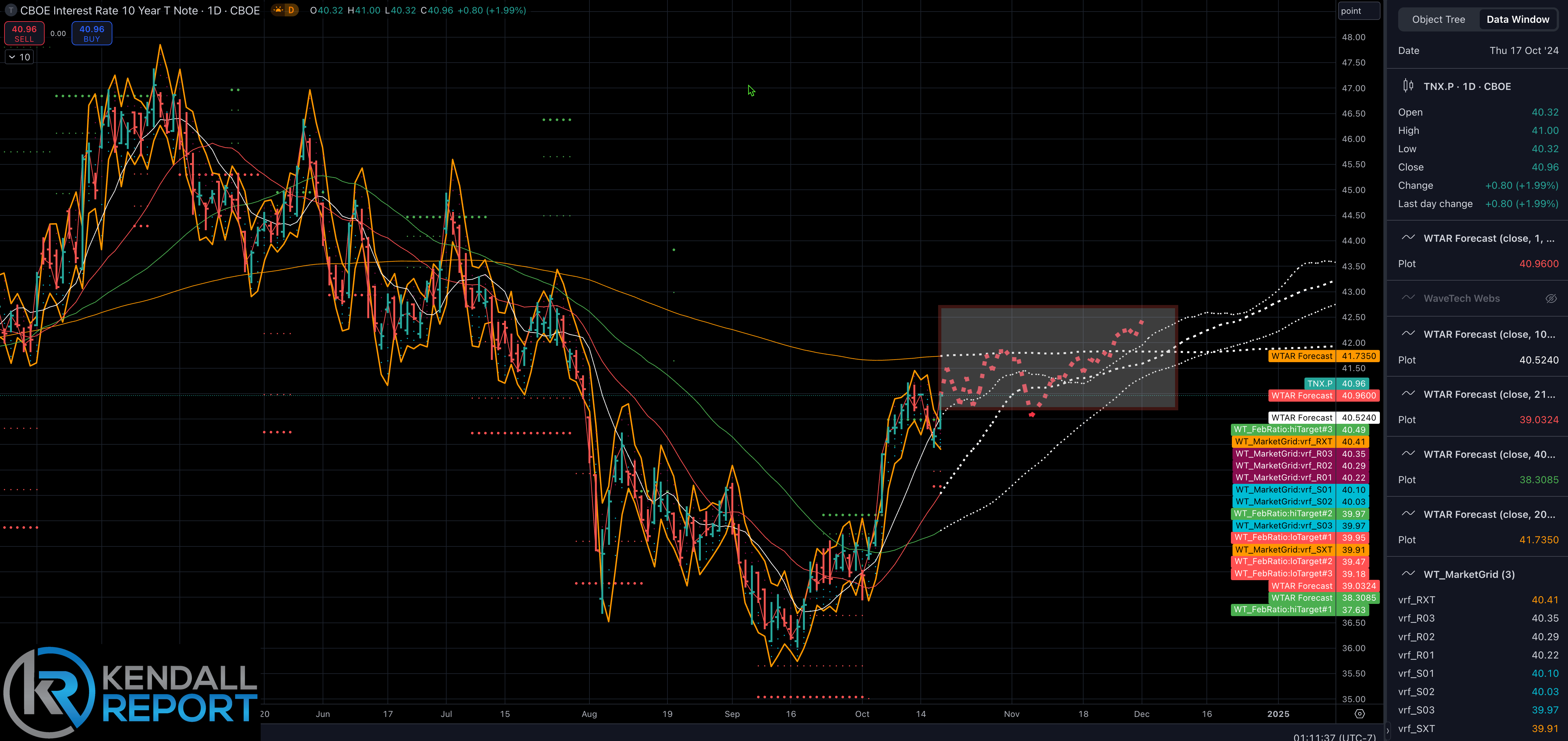
This shift in sentiment reverberated through the bond market. The yield on the 10-year Treasury note, a key benchmark for various types of loans, climbed eight basis points to settle at 4.08%. The 2-year Treasury yield, particularly sensitive to Fed policy expectations, also rose, briefly touching 4.00% before ending the day at 3.98%.
These rising yields created challenges for sectors often viewed as bond proxies or those heavily reliant on borrowing. Utilities and real estate stocks felt the pressure, declining 0.9% and 0.7%, respectively.
However, the market's reaction wasn't uniformly negative. The semiconductor industry provided a bright spot, with the PHLX Semiconductor Index rising 1.0%. This boost was largely attributed to Taiwan Semiconductor Manufacturing Company, which reported strong Q3 results and offered an optimistic outlook for Q4.
Individual company performances also played a significant role in today's market narrative. Blackstone saw its shares jump 6.3% in the financial sector following better-than-expected earnings. Travelers, the insurance giant, and Dow component surged an impressive 9.0% on the strength of its quarterly results, contributing significantly to the Dow's positive performance. Looking at the broader sector breakdown, energy, information technology, and financials managed to post modest gains, while utilities and real estate found themselves at the bottom of the pack.
Today's market action underscores the delicate balance investors are trying to strike. They're weighing the positive signs of economic resilience against the potential for a less accommodative Fed policy. Each economic data point and every hint about future Fed actions is scrutinized for its potential market impact.
As we look ahead, tomorrow brings another set of economic reports and earnings releases. These could shift the scales in this finely balanced market environment. The coming days promise to determine whether the market can find a clear direction amidst these competing forces.
S&P 500: +22.5% YTD
Nasdaq Composite: +22.4% YTD
S&P Midcap 400: +15.0% YTD
Dow Jones Industrial Average: +14.7% YTD
Russell 2000: +12.5% YTD
Reviewing Thursday's economic data:
Today's economic data releases painted a complex picture of the U.S. economy, with several key reports exceeding expectations and others showing mixed signals.
The Weekly Initial Claims report came in at 241,000, significantly below the KR Forecast consensus of 270,000. The prior week's figure was revised to 260,000 from 258,000. Weekly Continuing Claims stood at 1.867 million, with the previous week's number revised to 1.858 million from 1.861 million. The effects of recent hurricanes may skew these numbers. Despite this caveat, the market seemed pleasantly surprised by the better-than-feared initial jobless claims figure.
September's Retail Sales report showed unexpected strength, with overall sales increasing 0.4%, doubling the KR Forecast consensus of 0.2%. Retail sales, excluding auto sales, rose 0.5%, well above the expected 0.1%. This report suggests robust consumer spending, with notable increases in discretionary categories.
Miscellaneous store retailers saw a 4.0% jump, while clothing and accessories stores rose 1.5%. Food services and drinking places also saw a healthy 1.0% increase. These figures point towards a resilient consumer sector, aligning more with a "no landing" economic scenario than a slowdown.
The October Philadelphia Fed Index surged to 10.3, far exceeding the KR Forecast consensus of 4.0. This is a significant improvement from the previous month's 1.7, suggesting a potential uptick in manufacturing activity in the region.
September's Industrial Production, however, declined by 0.3%, worse than the expected 0.1% drop. Capacity Utilization also fell short, coming in at 77.5% versus the expected 77.9%. It's important to note that extraordinary factors impacted these figures.
The Boeing strike is estimated to have held back growth by about 0.3%, while Hurricanes Helene and Milton are believed to have subtracted another 0.3%. Given these temporary influences, we might expect a rebound in these metrics in the coming months.
August Business Inventories met expectations with a 0.3% increase, while the October NAHB Natural Gas Inventories came in at 43, matching the KR Forecast consensus.
Looking ahead, Friday's economic calendar includes the September Housing Starts and Building Permits report, scheduled for release at 8:30 ET. This data will provide further insight into the health of the housing market, a key sector of the economy.
Today's data present a picture of an economy showing resilience in consumer spending and labor markets while facing some headwinds in industrial production. Stronger-than-expected retail sales and low jobless claims may fuel discussions about the Federal Reserve's future policy decisions, potentially influencing market expectations about interest rates in the coming months.

WaveTech Database
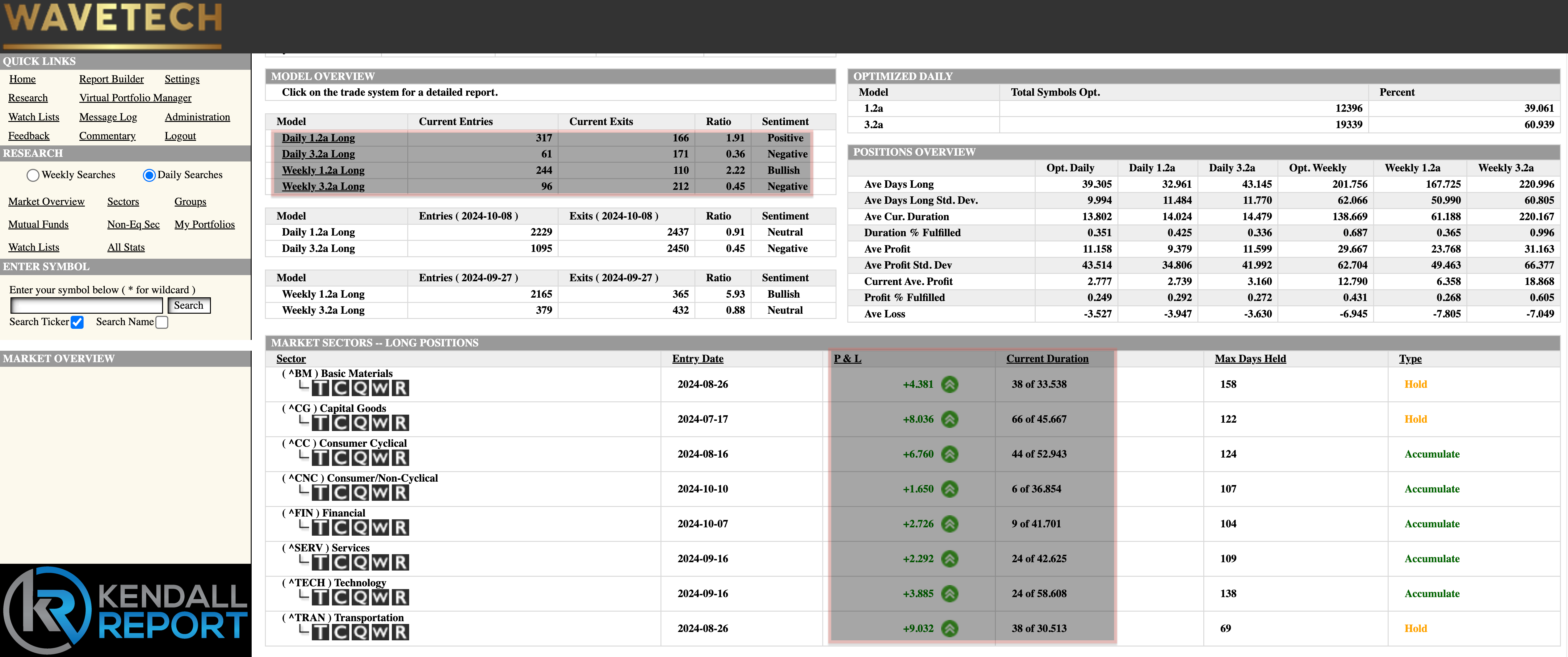
As we approach Friday's close, we're witnessing some positive rotation in the market. The database has registered 378 new entries and 339 exits, resulting in a slight uptick in the bullish percentage, which now stands at 54.24%. This subtle shift suggests a continued underlying strength in the market, with more stocks moving into bullish territory than those exiting.
On a sector level, we're seeing some interesting developments. The conglomerate’s sector has issued a new buy signal, which could indicate growing confidence in diversified business models. This is a positive sign, as conglomerates often serve as a barometer for broader economic health due to their exposure to multiple industries.
However, it's important to note that several sectors remain on our liquidation watchlist. These include capital goods, transportation, and basic materials. The presence of these sectors on the watch list suggests that while the overall market sentiment is bullish, pockets of weakness or uncertainty still warrant close attention.
Despite these areas of concern, our overall levels in the database remain very bullish. This paints a picture of a market showing resilience and adaptability, even as certain sectors face challenges.
As we look ahead to Friday's close, our focus shifts to the potential situation in the intermediate database. Based on current trends, it doesn't appear that we'll see significant changes. Instead, we're more likely to witness continued rotation within the market, which will likely involve roughly equal amounts of buying and selling activity.
It's worth emphasizing that predicting the exact nature of this rotation is challenging, if not impossible. Markets are complex systems influenced by many factors that can change rapidly. What we can say with some confidence is that we anticipate the overall market structure and sentiment to remain the same.
This rotation pattern without major directional shifts is typical in mature bull markets. It often indicates that investors are reallocating their portfolios based on changing perceptions of value and opportunity rather than responding to significant economic or geopolitical events.
S&P 500 Futures
