
Markets Remain Resilient!
Will Support Levels Hold?

KR opinion
As we reach the midpoint of the month, the market shows signs of further consolidation, with a likely downturn in the latter half of the month extending into May. I've previously discussed my expectation for a market bottom in mid-to-late May, followed by a summer rally.
In my recent YouTube video, I analyzed the core Consumer Price Index (CPI), which currently stands at 2.6%. I anticipate an increase in the CPI, potentially returning to between 3.2% and 3.7% over the next two quarters, which could be influenced by geopolitical risks or a general price rebound.
This pattern, which I call an "echo bounce," involves a sharp price increase, followed by a retracement and a partial recovery. This suggests that CPI could rise to 3.5% and 4% before returning to 2%.
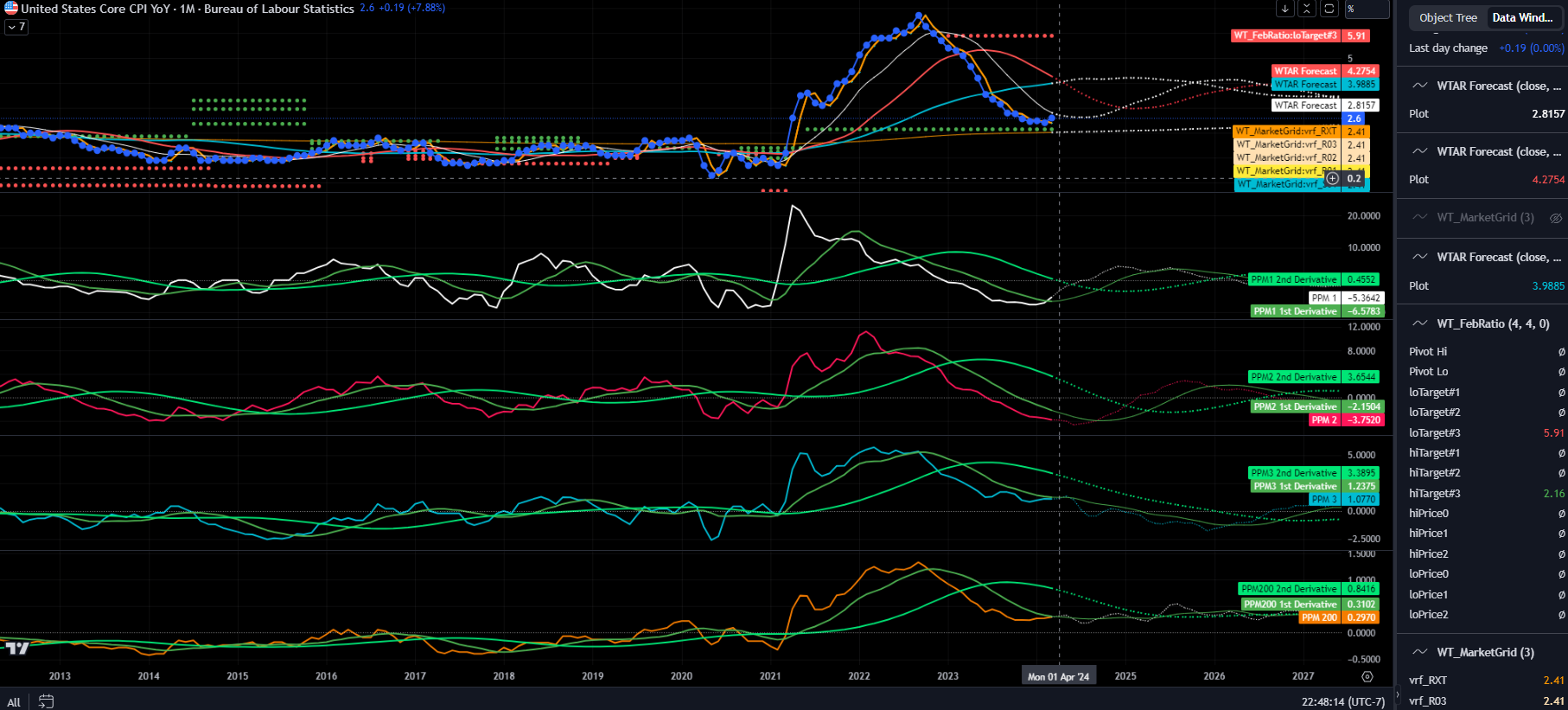
This scenario may lead the Federal Reserve to consider a modest rate hike of 0.25%, contrary to the widely expected rate cuts. This would align with historical patterns where market expectations of significant rate drops are met with rate increases instead. Despite persistent recession fears and discussions of a banking crisis over the last 18 months, no recession has materialized.
Furthermore, other factors such as geopolitical tensions, higher oil prices, and supply disruptions due to droughts could drive inflation, impacting food prices and other sectors. We expect these CPI increases to persist for the next two quarters before stabilizing.
This week, we anticipate continued market consolidation, with the S&P 500 hovering around the 5150 level. The technical section below provides a more detailed analysis of this.
Looking Back on last week
This week, the stock market experienced significant losses due to various factors that unsettled investors. First, there was a notable increase in market rates, which contributed to a negative sentiment. Additionally, there was a shift in expectations regarding potential interest rate cuts and escalating geopolitical tensions. Specifically, concerns arose about a possible conflict between Iran and Israel, adding to the overall uncertainty.
Even before these geopolitical concerns surfaced, the market reacted unfavorably to the March Consumer Price Index (CPI) report, which showed higher-than-expected inflation. The total CPI and core CPI, excluding food and energy prices, exceeded projections, fueling worries about inflationary pressures.
Although the Producer Price Index (PPI) showed a slightly lower-than-expected increase every month, the overall trend still indicated an acceleration in prices compared to previous months.
These developments led to concerns about the Federal Open Market Committee (FOMC) adopting a more hawkish stance on monetary policy, causing investors to reconsider their expectations for interest rate cuts. As a result, the probability of a rate cut at the upcoming June FOMC meeting dropped significantly compared to previous months.
Treasury yields surged in response to the economic data and a series of weak Treasury auctions throughout the week. Notably, yields on both 10-year and 2-year Treasury notes rose sharply.
Furthermore, the start of the Q1 earnings reporting season was disappointing, particularly for bank stocks. Comments from JPMorgan Chase CEO Jamie Dimon and unchanged guidance on net interest income contributed to the cautious sentiment. Other major banks like Citigroup and Wells Fargo also reported declining earnings, adding to the downward pressure on the market.
Overall, the S&P 500 experienced losses across all sectors, with financials being the worst hit due to weakness in bank stocks. Real estate, materials, and healthcare sectors also saw significant declines, influenced by various market factors, including rising interest rates.
Upcoming economic indicators with forecasts
Apr 15
- 08:30 ET: Retail Sales (Mar)
Trading Impact: High | KR Forecast: 0.3% | Consensus: 0.4% | Prior: 0.6%
- 08:30 ET: Retail Sales ex-auto (Mar)
Trading Impact: High | KR Forecast: 0.6% | Consensus: 0.5% | Prior: 0.3%
- 08:30 ET: NY Fed Empire State Manufacturing (Apr)
Trading Impact: Low | KR Forecast: -8.5 | Consensus: -6.0 | Prior: -20.9
- 10:00 ET: Business Inventories (Feb)
Trading Impact: Low | KR Forecast: 0.3% | Consensus: 0.3% | Prior: 0.0%
- 10:00 ET: NAHB Housing Market Index (Apr)
Trading Impact: Low | KR Forecast: 52 | Consensus: 51 | Prior: 51
Apr 16
- 08:30 ET: Housing Starts (Mar)
Trading Impact: High | KR Forecast: 1500K | Consensus: 1485K | Prior: 1521K
- 08:30 ET: Building Permits (Mar)
Trading Impact: High | KR Forecast: 1525K | Consensus: 1518K | Prior: 1518K
- 09:15 ET: Industrial Production (Mar)
Trading Impact: Medium | KR Forecast: 0.2% | Consensus: 0.4% | Prior: 0.1%
- 09:15 ET: Capacity Utilization (Mar)
Trading Impact: Medium | KR Forecast: 78.4% | Consensus: 78.6% | Prior: 78.3%
Apr 17
- 07:00 ET: MBA Mortgage Applications Index (04/13)
Trading Impact: Low | Prior: 0.1%
- 10:30 ET: EIA Crude Oil Inventories (04/13)
Trading Impact: High | Prior: +5.84M
- 14:00 ET: Beige Book (Apr)
Trading Impact: Low
- 16:00 ET: Net Long-Term TIC Flows (Feb)
Trading Impact: Low | Prior: $36.1B
Apr 18
- 08:30 ET: Initial Claims (04/13)
Trading Impact: High | KR Forecast: 219K | Consensus: 215K | Prior: 211K
- 08:30 ET: Continuing Claims (04/06)
Trading Impact: High | Prior: 1817K
- 08:30 ET: Philadelphia Fed Index (Apr)
Trading Impact: Low | KR Forecast: 3.0 | Consensus: 0.0 | Prior: 3.2
- 10:00 ET: Existing Home Sales (Mar)
Trading Impact: High | KR Forecast: 4.26M | Consensus: 4.20M | Prior: 4.38M
- 10:00 ET: Leading Indicators (Mar)
Trading Impact: Low | KR Forecast: 0.0% | Consensus: -0.1% | Prior: 0.1%
- 10:30 ET: EIA Natural Gas Inventories (04/13)
Trading Impact: Low | Prior: +24
WaveTech Database
